Warner University’s Response to U.S. Secretary of Education Linda McMahon’s “Call to Action” Letter
Recently, U.S. Secretary of Education Linda McMahon asked college and university leaders across the country to consider how they can help restore the public’s trust in American higher education. In a formal “Call to Action” letter, McMahon urged university leaders to publicly share their responses to seven categories of questions. Warner University thanks Secretary McMahon for her initiative and her concern for the integrity of the academy. Moreover, we appreciate the opportunity to explain how Warner University—an institution committed to historic Christian beliefs—has always resisted the trends, movements, theories, and philosophies that have caused so many institutions to drift from their original purposes.
1. How will Warner University ensure that its admission process is transparent and that admissions decisions are based on merit, achievement, and the institution’s educational purposes?
Truth and merit are at the heart of Warner University’s academic ethos as well as our admissions requirements. We recognize the academic achievement of all applicants, we publicly state our admissions requirements plainly and clearly, and we apply those requirements equally to every applicant.
Transparency and Merit in the Admissions Process
Our academic catalog, admissions pages, and printed admissions materials all list the requirements for admission. These requirements include a completed and submitted application, a minimum cumulative GPA for traditional first-year students, a minimum cumulative GPA for transfer students with 24 credit hours or more, official high school and/or college transcripts, and a clear statement that students will be expected to abide by the University’s published Community Commitments once enrolled. These criteria are used unilaterally, and there are no additional hidden standards by which admission is determined.
SAT, ACT, and CLT test scores are not required for admission at this time. Warner University encourages and accepts test scores for scholarship purposes; however, students may be admitted without submitting them. Like many institutions that implemented “test optional” admission requirements during the Covid-19 era, Warner University is currently reassessing this decision.
Notably, Warner University does not discriminate against any applicant on the basis of race or ethnicity in its admissions decisions. Such factors have never been considered in admissions decisions at Warner University.
Additionally, we are transparent about the cost of attendance. We list and publish every cost associated with attending Warner University, and we do so for traditional, in-person students as well as for non-residential and online students. There are no hidden fees. Prospective students and their families can find all attendance costs entirely online.
Finally, we award aid that students see. One hundred percent of traditional, on-campus students receive an institutional scholarship. Every year, Warner University awards over $10 million in merit-based aid.
Merit-Based Aid
Unapologetically, the University admits students and awards institutional aid based on merit. Institutional aid is awarded based on an objective cumulative GPA scale. Traditional, on-campus students are awarded academic scholarships determined by their cumulative high school or transfer GPA. Warner University also offers a premier scholarship showcase for first-year traditional students. The winner of this competition is awarded a scholarship covering the total cost of attendance, less any external aid that is applied to the student’s account; the runner up is awarded a scholarship covering the total cost of tuition, less any external aid applied to the student’s account; and every attendee receives a base annual scholarship for meeting the qualifying criteria and for competing.
As with admissions decisions, Warner University does not discriminate against any applicant on the basis of race or ethnicity in its scholarship decisions either.
2. How will Warner University ensure free speech and guard against unruly protest?
Protecting Freedom of Expression in Warner University’s Missional Context
As a Christian university committed to historic Christian beliefs, Warner University is, and has always been, driven by the pursuit and application of truth. As the great Christian educator Arthur Holmes wrote, “All truth is God’s truth.”[1]
Precisely because all truth is God’s truth, we need not fear where truth leads us. The University’s statement on academic freedom explicitly affirms this point: “Ultimately, there is no conflict in truth whenever and wherever it is found.” Herein lies a distinction between Warner University and many of today’s colleges and universities: we believe that truth exists and that it is objectively knowable. Unlike much of the academy, which has for decades denied the existence of objective truth, Warner University holds unapologetically to the idea that engagement with objective truth should be a foundational aspect of the educational experience. Campus speech codes and “safe spaces” implicitly communicate denial of objective truth’s existence and, in doing so, incline faculty, staff, and students to be overly sensitive about sharing ideas. Consequently, engaging in meaningful conversations becomes unnecessarily difficult in environments where free speech is discouraged. Truth might challenge us or make us uncomfortable, but we should not avoid it simply because we don’t like it—nor should we prevent others from presenting it. We regret that such a position has become controversial in many corners of higher education, but it is not controversial at Warner.
Because our institutional mission is “to provide an academically challenging, biblically faithful, culturally courageous education that equips students to serve Christ and excel professionally,” the free exchange of ideas is built into our DNA. That is, we recognize that academic rigor requires debate, that biblical faithfulness requires a commitment to all truth (since God is sovereign over it), and that cultural courage leads to the proclamation of truth regardless of its cultural popularity. One of Warner University’s biblical mandates is to promote reason and logic in the face of cultural chaos and confusion.
Through a workshop, Warner University’s faculty have been explicitly trained in how to facilitate open classroom dialogue and freedom of expression in the context of the institution’s Christian mission. Additionally, the University’s statement on academic freedom further underscores the University’s commitment to truth, opposed to intolerance or bias rooted in ideology:
Academic freedom is a protection for the student who has a right to have presented and to examine truth in all fields of study. To assure this protection, Warner University is committed to academic freedom in the best University tradition. Instructors have instructional freedom in discussing their subjects, but they should be careful not to introduce controversial matter that has no relation to their subject. As scholars, they should remember that the public may judge their profession and their institution by their utterances. Hence, they should at all times be accurate, should exercise appropriate restraint, should show respect for the opinions of others, and should make every effort to indicate that they are not speaking for the institution.
In short, we at Warner University pursue truth within the context of our Christian tradition, which recognizes (1) that truth exists, (2) that it is knowable, and (3) that the loving and sovereign God of our tradition authored this truth in the first place, so there is no need to fear it.
Guarding Against Unruly Protest
In the spirit of liberty, Warner University does not require or compel students to embrace the University’s Christian convictions. However, all students read and sign the institution’s Community Commitments, which are behavioral expectations informed by Christian teaching and intended to help ensure a safe learning community in which all people are treated with the dignity due them as creations of a sovereign and loving creator. As noted in this document,
We honor each person’s unique gifts and dignity; we show redemptive grace and compassion to each other by speaking the truth in love; and we foster an environment of transparency, authenticity, and unconditional love. We agree that preserving human dignity and protecting each other honors God and that harassment of any kind (verbal, sexual, racial, ethnic, etc.) will not be tolerated. These principles of the University are intended to help the members of the community live in unity.
While Warner University is anchored in the biblical pursuit and application of truth, it allows the free expression of alternative ideas and is committed to protecting such expression. In fact, in its Academic Integrity Policy, the University has included a statement demonstrating that it views not only plagiarism and other forms of academic dishonesty as violations of academic integrity, but also inappropriate conduct that would disrupt the learning environment and the pursuit of truth. Specifically, the Academic Integrity Policy communicates the following:
Demonstrations of inappropriate communication, disrespect, aggressive and disruptive behavior, and a belligerent attitude toward feedback or correction, either within or outside of the classroom in a learning or corrective situation, and either verbally or in writing, can disrupt the learning environment and/or the learning dynamic between students and faculty and are therefore prohibited.
Violations of such a nature are treated the same as violations of academic dishonesty. Thus, students who attempted to protest a campus event or guest in an unruly way would violate not only the institution’s Community Commitments but also the Academic Integrity Policy.
Notably, because the University is clear about its Christian values in its marketing, recruiting efforts, student and employee orientation processes, institutional policies, and campus ethos, disorderly protests and interruptions have never been a part of campus culture. Much of Warner’s constituency understands that the University has remained committed to Christian and historic American values, and it has a high regard for such commitment and the institution’s unapologetic clarity about it.
In the event that outside entities attempted to disrupt campus activities and impinge on the free expression of ideas, the University’s Emergency Management Policy appropriately addresses civil disturbances and demonstrations, and it provides guidelines for campus security personnel and leadership. This policy makes clear that unruly disruptions will not be tolerated, and it includes clear guidance about contact with the local Sheriff’s Office, with which the University works closely.
Again, Warner University’s educational activities revolve around the pursuit and application of truth. We believe such pursuits are essential for a healthy society, and disruptions to those pursuits are prohibited by clear policy as well as by institutional mission and ethos.
While Warner University strives to evaluate information through the lens of objective truth, it does not silence those who champion ideas that are antithetical to it. We may challenge them to consider those ideas in light of the University’s core convictions—especially the pursuit of truth—but dissenters are free to express themselves civilly.
Warner University respectfully urges the Secretary to consider that many faith-based colleges and universities have long resisted the philosophies, ideologies, and practices that have led to public suspicion about higher education. The type of education that Warner University provides is actually the antidote to many of the cultural problems anchored in higher education’s decades-long ideological agenda.
3. How will Warner University encourage intellectual pluralism, ensure that hiring and evaluation practices support academic vitality, and preserve integrity in research?
Intellectual Pluralism
As we have noted in our response to Question 2, we are committed to the pursuit and application of truth, and our response provides extensive detail about what that pursuit and application looks like with regard to freedom of expression, student dialogue, and academic freedom in connection with the research, inquiry, and presentations of our faculty members.
Here, we want to be clear about how our hiring, termination, and evaluation practices within the University’s academic units are intended to bring together skilled educators who are both unified by our shared beliefs, as presented in the Warner University Statement of Faith, and distinct in how they hold, express, and practice those same beliefs within their respective academic disciplines.
With regard to pluralism, we note theologian D.A. Carson’s comment that pluralism “is a surprisingly tricky word in modern discussion.”[2] Without straining at details, the challenges to the use of this word are related to whether we are (a) simply referring to the recognized fact that there are many views, (b) advocating for the value of pluralism and actively pursuing diversity for its own sake, or (c) taking the stance that all ideological and/or religious philosophies and systems are equally valid and can, in some way, all be said to be “true.”
Warner University would, of course, not deny (a) but would have some questions and concerns about (b) that are beyond the scope of this response. It is option (c), which Carson refers to as “philosophical or hermeneutical pluralism,” that would be of greatest concern to Warner University.
Carson notes the following:
Philosophical pluralism has generated many approaches in support of one stance: namely, that any notion that a particular ideological or religious claim is intrinsically superior to another is necessarily wrong. The only absolute creed is the creed of pluralism. No religion has the right to pronounce itself right or true, and the others false, or even (in the majority view) relatively inferior.[3]
Clearly, based on what we have already communicated in our response to Question 2, Warner University would take exception to this final understanding of pluralism, as we do hold to objective truths and believe that they can be known.
While we find it doubtful that this was the intended meaning behind the Secretary’s use of the term, we nevertheless found it concerning that the term was used, as it appears that either meaning (a) or (b) might be closest to what was intended. If so, we can wholeheartedly agree that we want our students to be aware of and exposed to the other ideas, beliefs, and perspectives that they will encounter during their time with us and for the rest of their lives.
Hiring, Evaluation Processes, and Academic Vitality
We unapologetically require prospective faculty members to review the institution’s Statement of Faith and provide a thoughtful response to each paragraph of it, and we make hiring decisions to ensure that those teaching our students will not undermine the teachings of the Bible and Christianity in their classrooms, in their offices, or in their private conversations with our students. However, our instructors should be aware of other views and perspectives, be able to explain them in terms that those holding the views would agree with, and be able to offer a careful, informed, and objective evaluation of the strengths, weaknesses, merits, and drawbacks of holding and/or living out these beliefs, values, or commitments. We are committed to providing our students with an education that helps them be aware of and skilled at addressing a diverse range of ideas, opinions, beliefs, and perspectives. In short, we seek out and recruit faculty members who are savvy about what the world has to offer in the marketplace of ideas and who simultaneously hold firm to the central tenets of the Christian faith.
In keeping with Warner University’s accreditation and the guidelines provided by our accrediting body, the university requires faculty members to meet the following qualifications:
- Faculty teaching baccalaureate courses should hold a doctorate or master’s degree in the teaching discipline or a master’s degree with a concentration in the teaching discipline (with a minimum of 18 graduate semester hours in the teaching discipline).
- Faculty teaching graduate and post-baccalaureate coursework should hold an earned doctorate or other terminal degree in the teaching discipline or a related discipline.
Furthermore, all of Warner University’s instructors and their courses are subject to ongoing evaluation by a variety of means, including anonymous student surveys. These assessments allow the University’s academic leadership to note instructor trends within any given semester and over time, as well as course trends for courses that are taught by different instructors in different formats, such as the in-person synchronous environment versus the online asynchronous one.
All full-time instructors are regularly observed in the classroom by a peer faculty member, their respective department chair, and/or the Chief Academic Officer. These classroom observations are documented and include an evaluation component that addresses what was done in the classroom as well as a reflection and feedback component to facilitate improvement related to areas of weakness. Part-time in-person instructors are observed in the classroom at least once per year by their respective department chair or the Chief Academic Officer.
The Chief Academic Officer evaluates and provides feedback to all full-time instructors on a regular basis. For instructors being considered for promotion to the next faculty rank, the Chief Academic Officer and Rank and Promotion Committee conduct a more comprehensive and in-depth evaluation during the academic year in which the faculty member is eligible for promotion. Warner University does not award tenure to faculty.
As noted above, and in keeping with our desire to prepare students who are “culturally courageous” when entering the workforce and society, Warner University endeavors to provide students with an education in which they are exposed to the world as it really is while holding to a biblical vision of how God would have it to be. Consequently, we address difficult, controversial, and sometimes divisive topics and information.
Below is part of a disclaimer we communicate to students to prepare them for the challenging conversations that sometimes arise in connection with addressing topics that make them uncomfortable:
We want you, our student, to know that we truly believe what we say we believe in our Statement of Faith, and we want to put our beliefs into practice in all that we do. As such, we are always examining the contents and approach of our various courses to make sure that what is included in them is in alignment with what we believe, and that our approach to handling certain challenging subjects is informed by our beliefs. That does not mean that we affirm or condone everything that is examined, engaged, discussed, or otherwise covered in our courses, such as other beliefs, philosophies, practices, views, etc.

So, our exposing you to alternate or opposing views should not be viewed as agreement with or advancement of those views. What we do want is for our students to both understand that others hold those views and understand why they do. Then, we want our students to be able to address which course content within a reading, article, and/or assignment would not be in alignment with a biblical, Christian worldview and identify why this is the case. Finally, we want students to be able to identify whether the flaws in the article arise from an error or errors in (1) the facts being examined or ignored, (2) stated or implied assumptions being held, (3) interpretation of the data being presented, and/or (4) wrong conclusions or applications being made based on flawed thinking and reasoning.

We want our students to be able to engage in winsome, charitable dialogue with those who hold different views, but we also want them to have a firm commitment to the truth of God’s Word without compromise or embarrassment.
This last sentence is especially important to Warner University, as we hold to the Christian doctrine of Imago Dei—the notion that every human being bears the image of God and should therefore be treated with dignity. This belief informs our communication with and instruction of our students, as well as how the University encourages students to interact with each other in our academic spaces.
Importantly, Warner University does not base its evaluation of its students’ work on the position(s) they hold, rewarding those who agree with our own stances and penalizing those who do not. Rather, the evaluation of a student’s work in which he or she advocates for a position is based on the strength and persuasiveness of the argument and the proper use of reliable, relevant evidence.
4. How will Warner University address affordability, the crisis of student-loan debt, and the long-term financial value of academic programs?
Warner University recognizes that affordability, transparency, student success, and workforce outcomes are interconnected responsibilities. Families should understand what a Warner education will cost, the resources available to help finance it, and the opportunities a degree can provide after graduation. At the same time, the University must ensure that its resources are managed responsibly and directed toward activities that support our students and advance our Christian mission.
Affordability and Responsible Stewardship
Warner is committed to an operating model that prioritizes instruction, student support, and the core functions of the University. As a smaller institution, we continually evaluate expenses and seek opportunities to operate efficiently rather than simply passing rising costs on to students and families.
One of Warner’s most significant investments in affordability is more than $10 million annually in institutional aid, which directly reduces the cost of attendance for our students. We continually evaluate our scholarship strategies to balance access and affordability.
We have also implemented practical measures to make educational costs more predictable. Through Warner’s textbook rental program, students pay a single flat rate that covers the textbooks they need each semester, with one established rate for full-time students and another for part-time students. Our textbook-rental program provides families with greater predictability and helps eliminate unexpected textbook expenses.
We also offer lower tuition for our online ministry programs, recognizing the value of preparing individuals who are called to ministry and Christian service. Our commitment to affordability is further supported through philanthropy. The Royal Fund for Excellence comprises the bulk of Warner’s fundraising efforts, providing resources that help strengthen the University, support the institutional mission, and provide scholarships to students.
Transparency and Financial Education to Address the Crisis of Student-Loan Debut
We believe that affordability must be accompanied by transparency. Our Student Financial Services team provides multiple financial aid brochures and resources that explain the types of assistance available and help families understand the financial aid process.
More importantly, financial education is personal. Our staff counsel students and families in person, remotely, and through digital communication, answering financial-aid questions and addressing concerns, explaining payment obligations, and providing information about available resources. We want families to have access to knowledgeable staff throughout the process rather than simply receiving an award notification. Importantly, this financial education begins before classes start. Warner conducts on-campus orientation sessions for new students and their families. These sessions help students and families understand the University’s academic, financial, and student-life expectations. Additionally, every freshman is required to complete the University’s first-year experience course, which provides a broader introduction to Warner and the resources, expectations, and information students need to successfully navigate their college experience and the financial responsibilities associated with it.
Retention, Completion, and Career-Preparation Foci Related to Educational Value
Retention is a significant component of Warner University’s strategic plan because we recognize both the personal and financial value of helping a student remain enrolled and complete a degree. Affordability cannot be measured solely by the price of attendance. A student who incurs educational costs but leaves without completing a degree may face a substantially different future financial situation than a student who persists through graduation. This reality is central to the University’s approach to retention and completion.
Internally, we intentionally refer to those we serve as “future graduates” rather than “students.” This terminology reflects our expectation that enrollment is only the beginning of the educational journey. Our responsibility is to help each individual progress toward degree completion and leave Warner prepared for what comes next.
Consequently, we make intentional efforts to create an experience that makes our students want to remain at Warner. We conduct academic monitoring for every student multiple times each semester. This monitoring allows us to identify concerns early and intervene before academic challenges become barriers to persistence or graduation.
We also provide internship opportunities that give students real-world experiences, connect their classroom learning to future careers, and strengthen their preparation for employment. Our academic programs must demonstrate value through meaningful educational experiences and identifiable pathways to employment, graduate education, professional advancement, ministry, or service.
5. How will Warner University incentivize rigor in the age of AI, combat grade inflation, and prioritize excellence in teaching and learning?
Like many of its peers, Warner University has been forced to grapple with issues arising directly from the introduction and availability of Artificial Intelligence (AI) tools. Prior to the public release of ChatGPT in late 2022, the most prevalent academic integrity issues involved plagiarism of all or a portion of a fellow student’s assignment, the use of a paper or other assignment obtained online from one of a number of websites providing such resources, and plagiarism consisting of the uncited use of material from online webpages and articles or other sources. However, in late 2022 and early 2023, as students discovered and made use of AI tools, AI became the most significant challenge to academic integrity.
Warner University has risen to the challenge by providing guidance about both the abuse and the proper use of AI tools. Further, we are laboring to explain to our students the moral commitments and theological positions that inform our decisions and concerns about AI.
To be clear, we recognize that AI has the potential to greatly enhance and enrich all human endeavors, and we appreciate how the responsible use of AI has already contributed to workplace efficiency and productivity. Warner University embraces these new tools, and we hope to continue to integrate their use into our curriculum in ways that position our students for success as they leave us and enter the workforce.
However, while AI, which is fashioned in the image of our own minds, might well prove to be humanity’s greatest development, Warner University still holds that our greatest commitment should be the education, the development, and the nurturing of human beings, who are fashioned in the image of God Himself. We do not believe that there is any creation of humanity that can or should be sought to supplant God’s own unique creation.
Incentivizing Rigor in the Age of AI
Warner University has adopted tools that help identify instances of the use of generative and/or paraphrastic AI and plagiarism. Through our use and evaluation of these tools, we have in some instances found them to be limited, wholly inadequate, or problematic—and we have switched to other tools, resources, and approaches upon such findings. Further, the university has developed academic integrity policies and procedures to provide accountability for students and guidance for instructors. Detection leads to discussion, and we encourage our instructors to seek first to understand the student’s research and writing process, identifying any challenges, obstacles, and/or missteps as they do so.
As the AI tools and students’ use of them continue to change, we will undoubtedly need to change, too. We are committed to ongoing, continual evaluation of and reflection about the effectiveness of our approaches to detecting, properly identifying, and addressing the use of AI.
In some cases, our instructors have determined that the best course of action has involved a move to in-person activities, such as handwritten assignments, quizzes and tests, live presentations in the classroom setting, or video presentations in online discussions. In other cases, classroom processes that require submissions of the various stages of an assignment—showing the progression of the work from the initial idea to one or more draft documents and then to the final, completed document—have helped clarify for students what is expected of them while also providing an accountability structure that discourages the use of AI to produce the end product. Further, Warner University has increased the relevant training for faculty, encouraging the active sharing of ideas, best practices, and success stories in faculty meetings and workshops.
We have also committed to the adoption of the most recent version of the Artificial Intelligence Assessment Scale (AIAS 2.1), as shown below:
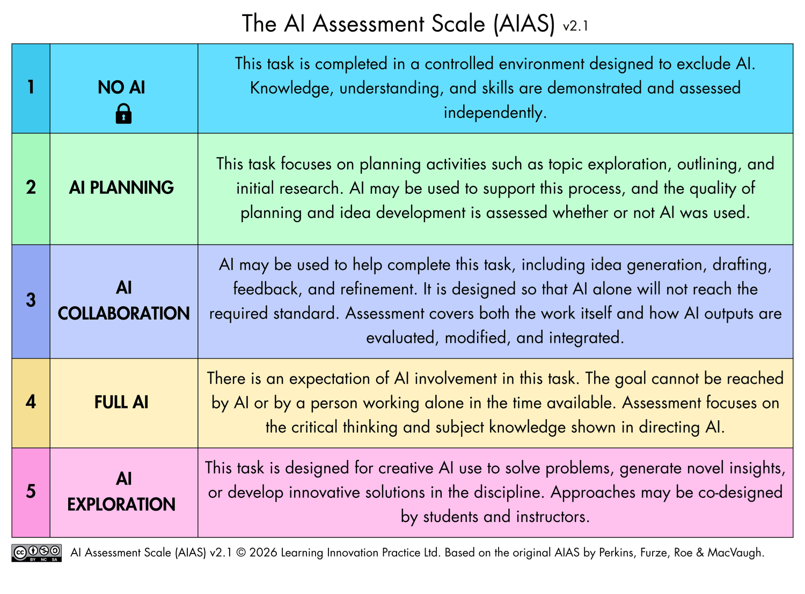
The default for assignments at Warner University is Level 1, in which the use of AI is strictly prohibited. For students to use AI, instructors must specify that it may be utilized and provide clear guidelines regarding its use.
Warner University’s positions on AI are in alignment with those of Florida state educators and administrators. We can wholeheartedly affirm the sentiments expressed by the Florida State Board of Education and Department of Education in September 2026:
An educated person can use a powerful tool without becoming dependent on it. That is the line Florida is drawing,” said Florida Commissioner of Education Henry Mack. “AI belongs in a classroom when it sharpens instruction, elevates or enhances the learning experience, protects privacy, and leaves the student’s own mind stronger than it found it. It does not belong in a classroom when it writes the essay, scores the child in secret, offers itself as a companion, or coopts the intellectual virtue of critical thinking. We are preparing Floridians for an AI economy. We are not raising a generation that outsources judgment or rationality.[4]
We take our mission seriously, and our stance regarding AI supports our ongoing effort “to provide an academically challenging, biblically faithful, culturally courageous education that equips students to serve Christ and excel professionally.” To adequately equip our students, we must instruct students in the ethical, responsible use of AI to support, not supplant, their own learning and development.
Combatting Grade Inflation and Prioritizing Excellence
Warner University recognizes that grade inflation is an ongoing issue that acutely affects not only the primary and secondary levels of education, but also tertiary or higher education. We are affected by grade inflation, especially in high school, as the grade point average (GPA) has become a less reliable indicator of a student’s performance in high school and preparedness for college.
We have also recognized that many students come to us unprepared to make full use of the various tools that they would need to be successful—knowledge about email, file storage, our learning management system (LMS), citation guides, research databases, etc. Bringing together faculty members from the various disciplines, we developed a new first-year experience course to prepare incoming students for success in their undergraduate work and their university experience. This course is continually reviewed and assessed to ensure it is achieving the desired outcomes, and it has been changed accordingly each year to better serve our incoming students and give them the foundational knowledge and skills they need to succeed in their coursework.
Our courses are designed, developed, taught, and reviewed by qualified faculty members with experience and expertise in their respective academic disciplines. All full-time faculty are involved in faculty governance, proposing, reviewing, and approving all curricular and academic policy changes.
Our course syllabi and supporting-activity instructions make clear what is expected from students and how their work will be assessed. These expectations are the same for all of the students taking the course, and instructors fairly and impartially evaluate each student’s work based on its own merit. All Warner University instructors keep regular weekly office hours during which any of their students may visit to receive assistance, feedback, and guidance.
We also provide resources necessary to support student learning—including our Academic Center for Excellence and peer tutoring—and endeavor to identify early in the semester when students might be struggling with their coursework so that we may intervene appropriately. We actively review the courses that students find most challenging, and we adjust our interventions and supportive measures for students accordingly.
6. How will Warner University protect academic programs from foreign influence and safeguard the integrity of the research enterprise?
While the institution celebrates faculty accomplishments in research, and while its Faculty Rank and Promotion process rewards faculty members for research activities, Warner University is proudly and intentionally a teaching university. As noted in the Faculty Handbook, “Full-time faculty members are those whose primary responsibilities are to teach and advise students.”
Because classroom instruction is the primary focus of the institution’s operations, it does not concern itself with foreign relationships that would undermine its integrity. Virtually all of the University’s interaction with foreign nations is related to Christian missions—educational and service experiences for faculty, staff, and students. Moreover, the University’s international-student enrollment is very limited. The institution has been involved with only two (2) H-1B approvals in the last eight years, and it has accepted no foreign gifts of which current leadership is aware.
7. How will Warner University advance American interests, meet workforce needs, and contribute to the nation’s prosperity?
Warner University is unapologetically pro-American. We understand that the Judeo-Christian values that have been foundational to the success of the American experiment and Western progress should be celebrated, championed, and taught. Students at Warner University are not indoctrinated with anti-American, anti-Christian, anti-Semitic, anti-sanctity-of-life, anti-free-speech, anti-free-market, anti-Western, or anti-merit dogma. In this regard, Warner sets itself apart from a large swath of the American higher education landscape—and it does so with resolve and conviction.
Warner University aligns its academic program-development priorities with the workforce needs of its region. In its most recent strategic planning process, institutional leaders utilized state workforce data to determine the programs the University should offer to best serve its regional constituency and economy. While some programs identified in the process would require prohibitive start-up costs, the University has entered into articulation agreements with a like-minded institution to do its part in addressing the workforce needs related to some of those programs.
In its existing academic programming, the University also emphasizes productive workforce engagement. For example, Agricultural Studies majors must log 500 hours of hands-on experience through practicums and a capstone experience prior to graduation. These experiences help develop in students the professional skills that will contribute to a healthy workforce. Business majors must complete a capstone course in which they partner with local and regional businesses to conduct research that helps those businesses address actual problems. In recent years, students enrolled in this course have helped almost twenty (20) local businesses and a host of other regional businesses. Moreover, the University offers tuition discounts for local educational partners and emergency first-responders. Also, in the review process for academic programs, faculty are required to solicit feedback from experts in the career fields associated with the content of the academic disciplines they teach.
Conclusion
Warner University’s mission to “provide an academically challenging, biblically faithful, culturally courageous education that equips students to serve Christ and excel professionally” is a mission that, we believe, contributes to the nation’s prosperity. The mission statement’s attention to academic rigor and professional excellence communicates the institution’s understanding of its civic responsibility; the statement’s attention to biblical Christianity communicates understanding of the values that are foundational to civic prosperity; the statement’s attention to cultural courage underscores understanding that the values of freedom, liberty, and truth will always be challenged but that they must be defended and promoted; and the statement’s attention to Christ communicates the institution’s understanding that it is accountable to an entity far greater than the University itself and that its work is of eternal consequence.
[1]. Arthur Holmes, All Truth is God’s Truth, (Eerdmans, 1977).
[2]. D. A. Carson, The Gagging of God: Christianity Confronts Pluralism, Fifteenth Anniversary Edition (Zondervan, 2011), 13.
[3]. Carson, The Gagging of God: Christianity Confronts Pluralism, 19.
[4]. Florida DOE Press Office, “Florida Sets National Standard for Responsible AI in Classrooms—From VPK Through CollegeFlorida Sets National Standard for Responsible AI in Classrooms—From VPK,” September 24, 2026, https://www.fldoe.org/newsroom/latest-news/florida-sets-national-standard-for-responsible-ai-in-classroomsfrom-vpk-through-college.stml.


